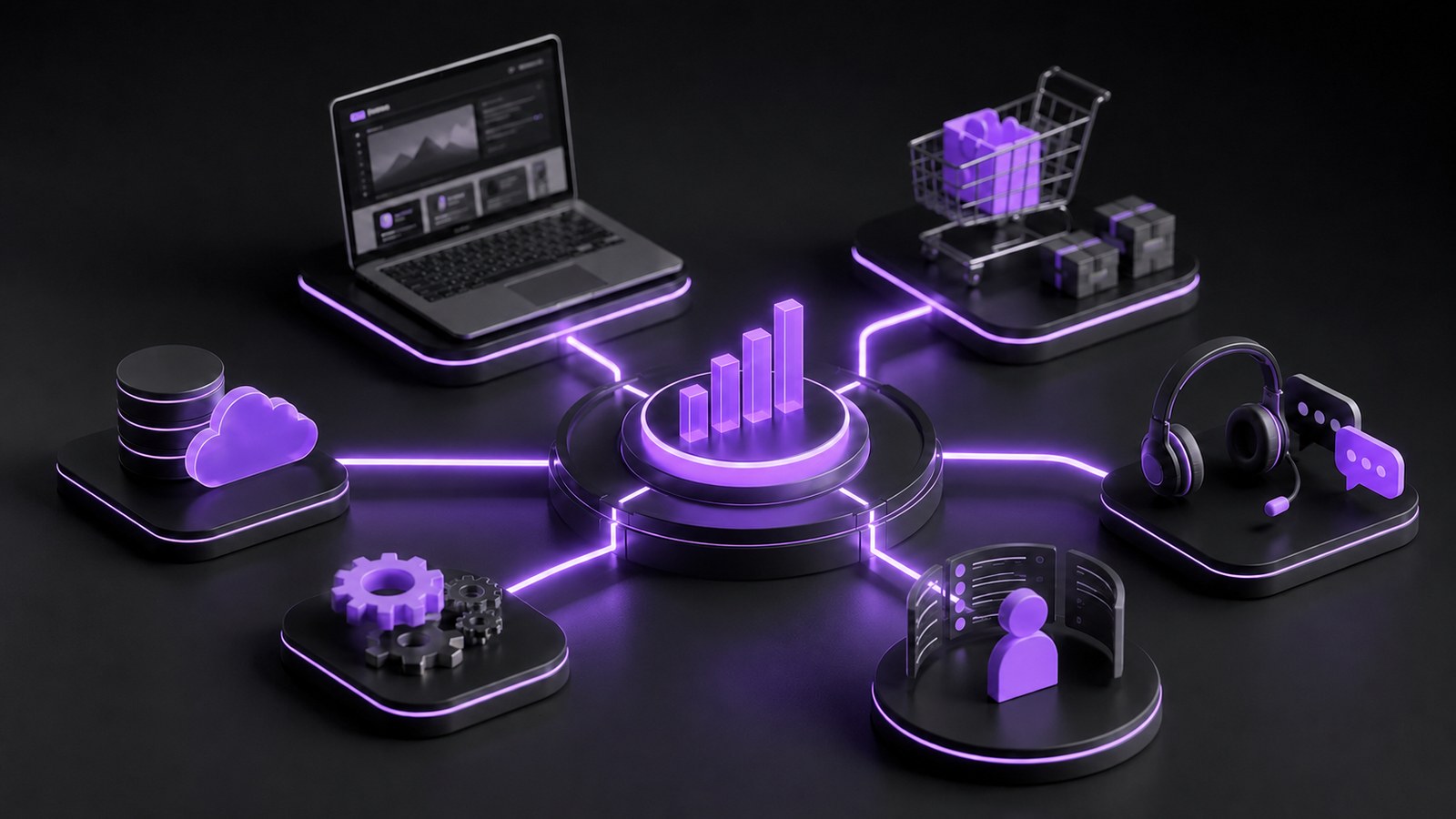
Many companies incorporate tools as a need arises: a website, a spreadsheet, a billing system, WhatsApp, and an email platform. Each solution solves something, but over time the information becomes fragmented, and growth requires repeating tasks or migrating everything.
Preparing a scalable digital structure doesn't mean buying the biggest system. It means making decisions that allow for connecting processes, conserving data, and expanding capabilities without rebuilding from scratch.
Start with the customer journey
Before choosing technology, describe how a person discovers the company, consults, purchases, receives the service, and returns. This map shows what information is generated, who uses it, and where time is lost. The architecture should support that journey.
Define a reliable source for each piece of data
Contact can originate on the web, but its follow-up should live in a CRM. The catalog can be displayed on multiple channels, although stock and prices need a single source of truth. This definition avoids conflicting versions and facilitates future integrations.
Build a web application ready for connection
An organized structure, well-defined forms, and tools with available integrations allow for later automation. WordPress and WooCommerce can function as the visible core while connecting with billing, inventory, marketing, or support.
Automate in stages
First, it's advisable to resolve frequent and stable tasks. Once that flow is working, new connections are incorporated. Automating a confusing process only speeds up confusion, which is why it needs to be documented, responsibilities assigned, and exceptions considered.
Manage access and continuity
The company must maintain control over domains, hosting, accounts, copies, and documentation. It also needs role-based permissions and a procedure for user onboarding and offboarding. Scalability includes security and recoverability.
Measure the impact
Each addition should answer a question: Does it reduce time? Does it decrease errors? Does it improve attention? Does it increase conversions? Measuring before and after avoids accumulating tools that add cost without solving the problem.
A flexible foundation, not a rigid structure
The goal is to create modules that can evolve. Perhaps today a form connected to a CRM is enough, and tomorrow a store, automation, or ERP can be added. If the data and processes were designed with foresight, the change will be an extension and not a restart.
At Pixie Estudio, we combine web development, WordPress, WooCommerce, automations, and integrations to build solutions tailored to each stage. Tell us how your company works today. and let's design the next step.